 Blog
Blog
 Blog
Blog
Update on
April
2026
Update on
02
2026
A website stands on four essential pillars:

In this guide, we focus on the first two pillars — Domain & Hosting — because these are the roots of your website.
If the roots are not under your control, everything built above them becomes unstable .
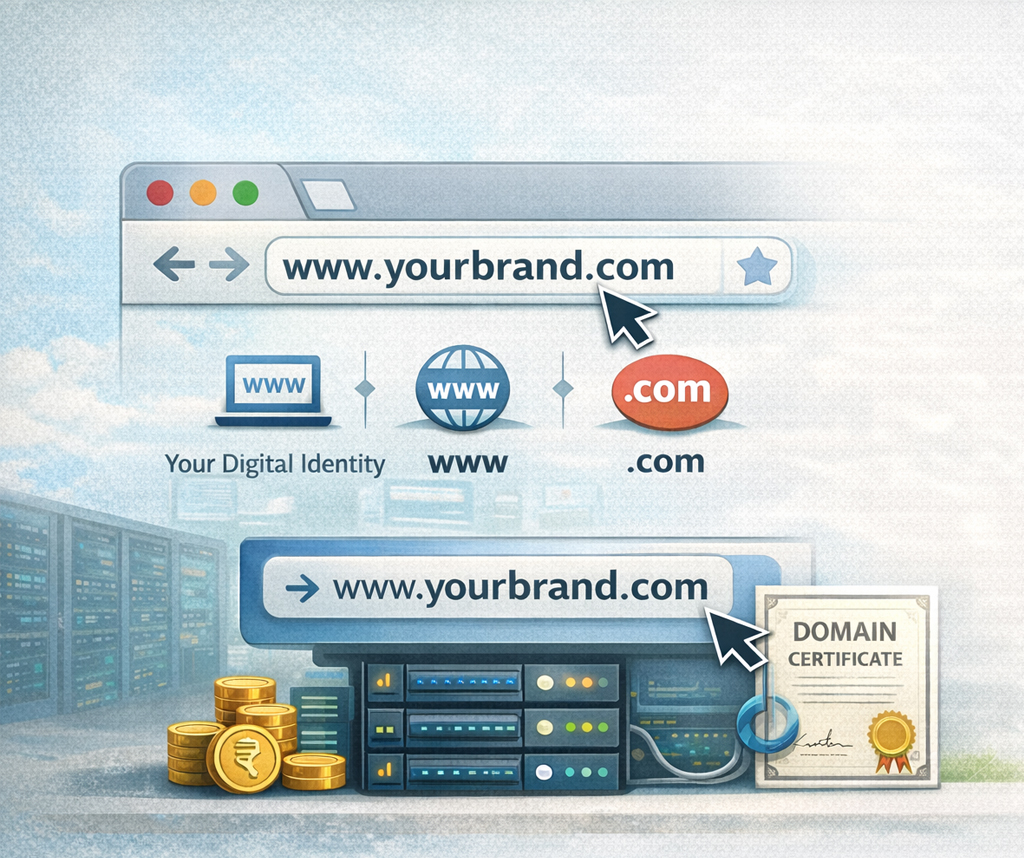
A domain is the registered name that identifies your business on the internet, such as yourbrand.com. It functions as your digital identity and connects users to your website through a hosting server. Maintaining clear domain hosting ownership is essential to protect your brand, prevent disputes, and secure long-term control over your online assets.
It represents:
Without domain ownership, you don’t fully control your digital identity. Even if you hire a freelance web designer and developer, the domain must always be registered in your name.

Hosting is the server space where your website’s files, databases, emails, and backups are stored. It ensures that your website remains accessible to users 24×7 across the internet. Without reliable hosting, even the best-designed website or web application cannot function properly.
It stores...
It ensures your website stays online 24×7.
Think of it this way:
Your web developer builds your digital house — your website or web application. They construct the layout, add features, and make everything operational.
But the land and address — your domain and hosting — are the foundation of that structure. If you don’t own them, you don’t fully control your digital infrastructure. True security begins with ownership.
Whether you’re building a corporate website or doing web app development freelance, hosting quality directly impacts performance, security, and uptime.
Many businesses hire a freelance web developer in India or even a development agency to build their website or web application. That’s perfectly fine.
As a domain hosting consultant, we regularly handle real-life issues such as:
Yes, some disputes get resolved legally or through cyber crime channels — but by then:
Most of these problems are avoidable with proper domain hosting ownership from the beginning.
When buying a domain, ask these questions...
Many businesses focus only on the attractive first-year offer and promotional discounts, without paying attention to what happens after that period ends. Hosting and domain providers often offer very low introductory prices, but the renewal cost can be significantly higher.
Always confirm the renewal pricing, billing cycle, and any additional charges before making a purchase decision. Understanding long-term costs protects you from unexpected expenses and future disputes. This simple step is a crucial part of any proper domain hosting buying guide.
Hosting cost depends on...
A professional trustworthy domain hosting provider explains these clearly — not after purchase, but before.
Many advertisements promote “Unlimited Hosting”.
The reality is...
A properly optimized website usually needs:
Even large websites built by a freelance web development team often use only a few hundred MB if properly optimized. Always read the SLA (Service Level Agreement).
| Hosting Type | Best For | Performance Level |
|---|---|---|
| Shared Hosting | Small & medium business websites | Cost-effective start |
| VPS Hosting | Growing websites & applications | Better control & stability |
| Cloud Hosting | High-traffic & scalable systems | High uptime & flexibility |
| Managed Hosting | Non-technical business owners | More cost, more peace |
Choose based on business need — not advertisements.
A responsible freelance web developer or experienced development team will guide you before purchase — not after damage.
At Shirsendu and Team, we treat domain and hosting as digital infrastructure responsibility.
We:
We support domain & hosting only for clients working with us for:
This creates accountability — not dependency.
Before hiring a freelance web developer or development team, confirm who will own the domain and hosting account.
Always review renewal costs, service limits, and SLA policies in advance so there are no surprises later.
Ensure your domain and hosting are registered in your name with full access to cPanel, DNS, and backups.
Clear ownership and transparency prevent future disputes, technical lock-ins, and unnecessary business stress.
Your domain and hosting are not small technical purchases — they are foundational business assets.
If you lose control of the roots, the entire digital structure becomes vulnerable.
