 Blog
Blog
 Blog
Blog
Update on
August
2026
Update on
JAN
2020
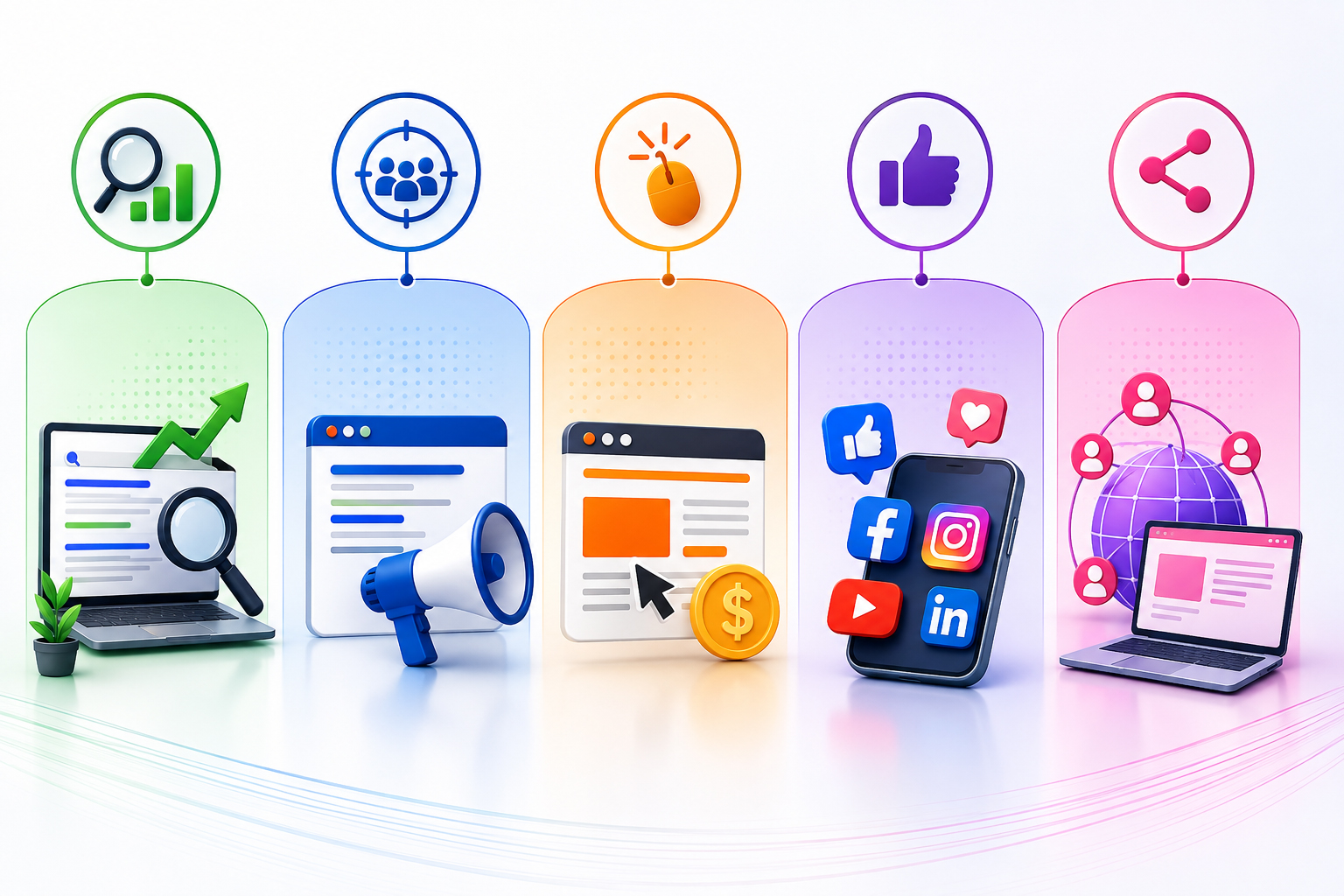
If you are trying to promote your business online, you have probably come across terms such as SEO, SEM, PPC, SMM and SMO. They are often discussed together, but they do not mean the same thing.
For a business owner, the real question is usually much simpler:
Which one can help my business get found online, attract the right audience and generate enquiries or sales?
SEO helps you build organic search visibility. SEM and PPC can help you reach potential customers through paid advertising. SMM focuses on marketing through social platforms, while SMO helps improve how effectively your business and content are presented and discovered on those platforms.
Understanding these differences can help you decide where to invest your time and marketing budget.
| Term | Full Form | Main Channel | Paid or Organic? | Main Objective |
|---|---|---|---|---|
| SEO | Search Engine Optimization | Search engines | Organic | Long-term search visibility |
| SEM | Search Engine Marketing | Search engines | Primarily Paid | Reach people actively searching |
| PPC | Pay-Per-Click | Search, social and other platforms | Paid | Generate targeted traffic quickly |
| SMM | Social Media Marketing | Social platforms | Organic + Paid | Awareness, engagement and leads |
| SMO | Social Media Optimization | Social platforms | Primarily Organic | Improve social visibility and engagement |
SEO stands for Search Engine Optimization.
SEO is the process of improving a website and its content so that search engines can better understand it and potential customers can find relevant pages through organic search results.
Suppose someone in Kolkata needs professional SEO support and searches for an SEO Freelancer Kolkata or an SEO Services Provider in Kolkata. Search engines try to identify pages that are relevant, useful and trustworthy enough to satisfy that search.
SEO therefore goes far beyond inserting keywords into a webpage.
It can involve:
A few years ago, businesses often thought of SEO primarily in terms of keywords and Google rankings.
Today, search is considerably more complex.
Users may encounter traditional organic results, local results, videos, images, featured information and AI-generated search experiences while researching a product, service or company.
Therefore, businesses investing in SEO in Kolkata or anywhere else should think beyond individual keyword positions.
The website needs to clearly communicate:
Who you are.
What you offer.
Who you serve.
Where you operate.
Why your information is useful.
Why a potential customer should trust your business.
Modern SEO is ultimately about making a business more useful, understandable and discoverable throughout the search journey.
Good content alone cannot solve every search visibility problem.
Search engines also need to be able to crawl, understand and index a website efficiently. Problems involving site architecture, indexing, page speed, mobile usability, redirects, canonicalization, structured data or other technical elements can affect organic performance.
This is why businesses evaluating Technical SEO Services in Kolkata should look beyond a simple keyword-ranking package. Technical SEO should identify and resolve issues that may prevent otherwise valuable pages from performing effectively in search.
SEM stands for Search Engine Marketing.
In modern digital marketing usage, SEM generally refers to paid marketing through search engines.
Suppose someone searches:
“SEO agency near me”
A business can run a search advertising campaign so that its ad has an opportunity to appear for relevant searches.
SEO attempts to earn organic visibility over time, whereas SEM allows businesses to pay for advertising visibility.
The simplest distinction is:
SEO = Organic search visibility
SEM = Paid search visibility
SEO generally requires time and consistent optimization. SEM can potentially provide visibility much faster, but it requires an ongoing advertising budget.
For many businesses, the best decision is therefore not necessarily choosing one over the other.
SEO can build sustainable organic visibility, while paid search can target important commercial searches where immediate exposure is valuable.
PPC stands for Pay-Per-Click.
PPC is an online advertising model where advertisers can pay when someone clicks their advertisement.
Search advertising is one of the best-known applications of PPC, but PPC is not limited to search engines. Click-based advertising models can also be used across social media and other digital advertising platforms.
This gives us an important distinction:
SEM describes paid search marketing.
PPC describes a payment model that can be used for search and other types of digital advertising.
No.
This is an important point for businesses to understand.
Paying for a click gets someone to the next stage of the journey. It does not guarantee an enquiry or sale.
Successful PPC usually requires:
Right audience → Right keyword/targeting → Right advertisement → Right landing page → Right offer → Conversion
A campaign may generate hundreds of clicks and still perform poorly if the landing page is confusing, the offer is weak or the audience targeting is incorrect.
That is why PPC should be measured by meaningful business results rather than clicks alone.
SMM stands for Social Media Marketing.
It refers to using social media platforms strategically to promote a brand, product or service and communicate with potential and existing customers.
Depending on the target audience, businesses may use platforms such as Facebook, Instagram, LinkedIn, YouTube, Pinterest or X.
SMM can include:
The biggest difference is often customer intent.
Someone searching Google for:
“SEO Company in Kolkata”
is already looking for a particular type of service.
But someone scrolling through LinkedIn, Facebook or Instagram may not currently be searching for an SEO service. A useful post, case study, video or advertisement may introduce the business and create interest.
Search marketing often helps businesses capture existing demand.
Social media can help businesses create awareness and influence future demand.
SMO stands for Social Media Optimization.
SMO involves improving your social media presence and content so that people can more easily discover, understand and engage with your brand.
It may involve optimizing:
This has become increasingly relevant because users do not discover businesses exclusively through traditional search engines.
People may search directly on Instagram, YouTube, LinkedIn or other social platforms for products, services, recommendations, tutorials and brands.
Therefore, social content should not simply be published. It should also be optimized for the way the intended audience discovers and consumes information.
The easiest way to understand it is:
SMM is your overall social media marketing activity.
SMO is the process of improving your social presence and content so that those activities perform more effectively.
For example, publishing an Instagram campaign for a new service is SMM.
Improving the profile, content format, captions, keywords, links, posting strategy and calls-to-action based on audience behaviour is SMO.
They work best together.
Imagine you have recently launched an interior design business.
You create optimized service pages, location pages and useful content addressing questions potential customers search for.
Objective: Build sustainable organic visibility.
You advertise when potential customers search for interior design services.
Objective: Reach people demonstrating immediate search intent.
You run paid campaigns and pay according to the advertising model being used, such as clicks.
Objective: Generate targeted traffic and enquiries quickly.
You publish project photographs, before-and-after transformations, design tips, reels and customer stories.
Objective: Generate awareness, engagement and trust.
You improve your social profiles, captions, content formats, keywords, links and publishing strategy.
Objective: Increase discoverability and engagement.
This is why digital marketing works best when individual channels support a broader customer journey.
There is no single answer for every company.
If your priority is long-term organic visibility, SEO deserves attention.
If you need immediate visibility for high-intent searches, SEM or PPC may be useful.
If your product needs visual discovery, community engagement or continuous brand communication, SMM and SMO may play a larger role.
And in many cases, businesses need a combination.
A local business, for example, may benefit from SEO, local search optimization and targeted advertising. An eCommerce company may combine SEO, paid campaigns, social media and remarketing. A B2B company may rely heavily on organic search, paid search and professional social platforms.
The important question is not:
“Which digital marketing method is best?”
Instead, ask:
“Where are my customers looking for businesses like mine, and what information do they need before choosing one?”
A customer journey rarely happens through one channel.
Someone may first discover your company through social media.
Later, they search your brand on Google.
They read an article on your website.
A few days later, they search for the service again and encounter your advertisement.
Eventually, they return to your website and submit an enquiry.
SEO, PPC and social media may therefore contribute at different stages of the same buying journey.
This is also something businesses should consider when comparing different SEO companies in Kolkata or broader digital marketing providers. Ranking reports alone do not tell the entire story. Search visibility should ultimately contribute to relevant traffic, enquiries, conversions and business growth.
You do not pay a search engine for each organic click generated through SEO. However, SEO itself involves investment in areas such as strategy, content, technical improvements, website development, optimization and professional expertise.
Google Ads is not SEO. Search advertising through Google Ads falls under paid search marketing or SEM.
Not exactly. SEM focuses on paid search marketing, while PPC is an advertising payment model that can be used on search engines, social platforms and other advertising networks.
Yes. PPC can provide faster paid visibility while SEO works toward developing sustainable organic visibility. Using data from both channels can also help businesses better understand search behaviour and conversion opportunities.
No. Running paid Google Ads does not directly improve a website's organic search rankings.
SMM is the broader process of marketing through social media. SMO focuses on optimizing profiles, content and social activity to improve visibility, discoverability and engagement.
SEO, SEM, PPC, SMM and SMO are not five competing strategies. Each solves a different part of the digital visibility problem.
SEO helps businesses develop organic search visibility.
SEM and PPC provide paid opportunities to reach targeted audiences.
SMM helps businesses communicate, engage and build awareness through social platforms.
SMO helps improve the discoverability and effectiveness of that social presence.
The right combination depends on your audience, competition, objectives, budget and current digital presence.
For businesses looking for Online Marketing Services in Kolkata, India, the priority should therefore be more than purchasing separate SEO, PPC or social media packages. The strategy should connect these channels around the way real customers discover, evaluate and contact a business.
Shirsendu & Team (SD Team) works with businesses across SEO, online marketing, web development and digital strategy. As an experienced SEO Services Provider in Kolkata, the team focuses on building a connected digital presence—from technical website improvements and organic search visibility to paid and social marketing—based on the actual requirements of the business.
Because traffic alone is not the objective.
The objective is to turn the right visibility into meaningful business opportunities.
